The assignment of a title is a significant moment in the creative process of each of Laura Roca’s works. So, if the word shadow appears in the exhibition title and in a dozen of the works on display, we must infer that, without doubt, the presence of shadow is an essential component of the artist’s recent work and, at the same time, a key to retrospective interpretation of the entirety of her extensive career. This is no trivial matter, considering the fundamental importance of the shadow in the history of art, where it plays a leading role both in Plato’s reflection on the image and in the myths about the origin of painting and the visual arts, as narrated by Pliny.
The photographic technique provided another way of fixing the ephemeral and evanescent shadow which, according to myth, was at the origin of painting. However, Proust himself established a link between the photographic record and the nuanced effort of Elstir, an imaginary Impressionist painter, to capture the subtle landscape variations of light and shadow. Throughout these recent years of fascination with shadow, Laura Roca has not shunned photography, but nor has she ever forgotten her painterly vocation, underpinned by a solid knowledge of printmaking techniques which often surface in her works.
Laura Roca’s photographs of shadows show that her interest lies not in the projected shadow and the object that causes it, but in the texture of the surface that hosts the shadow, in the way the shadow integrates into its relief. These photographs are presented as a mosaic of non-consecutive stills from an imaginary film (‘Shadow Map’), serve as a model for a composition of drawings that form a ‘Land of Signs’, or serve as a basis for subsequent manipulation with grattage and paint (in the ‘Illustrated Shadow’ series).
In this latest procedure we find the distinctive feature of the artist’s most profound and intense work, in which the shadow refers, in Marguerite Duras’s expression, to the “inner shadow”, to the shadow as a negative entity related to absence, oblivion, the unknown. In the shadow zones embedded in biography, which find in geological strata a metaphor inscribed in geography. The work of successive layers that overlap and are subsequently shaped with different techniques results in subtly volumetric works, with their own shadows coexisting with luminous areas; works that invite us to look in depth and ask the viewer for a perceptual and introspective exercise that sheds light on their own inner world.
Ramón Espelt
Text written by Ramon Espelt (professor and writer), on the occasion of the exhibition Jocs d’ombra at the ART 7 gallery (Manresa, June 2011).
Exhibition leaflet (PDF in Catalan)
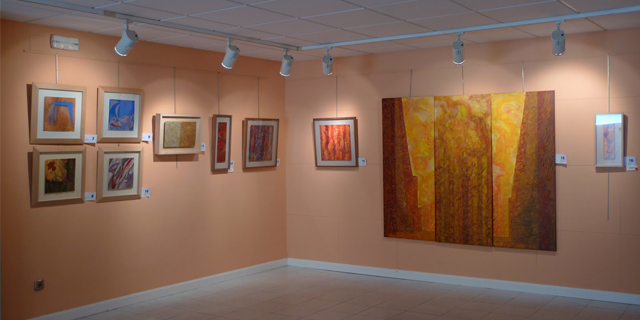
Photograph: one of the exhibition rooms.
 (Català) Exposició individual Jocs d'Ombra, Manresa 2011
 (Català) Exposició individual Miratges, Montcada 2006